
How to Backtest an Iron Condor Strategy
The iron condor is one of the most popular options strategies for generating consistent income in range-bound markets. But how do you know if it actually works for your target stock? Backtesting gives you the answer.
What is an Iron Condor?
An iron condor combines two credit spreads:
- Bull put spread (below current price) — Sell a put, buy a lower-strike put
- Bear call spread (above current price) — Sell a call, buy a higher-strike call
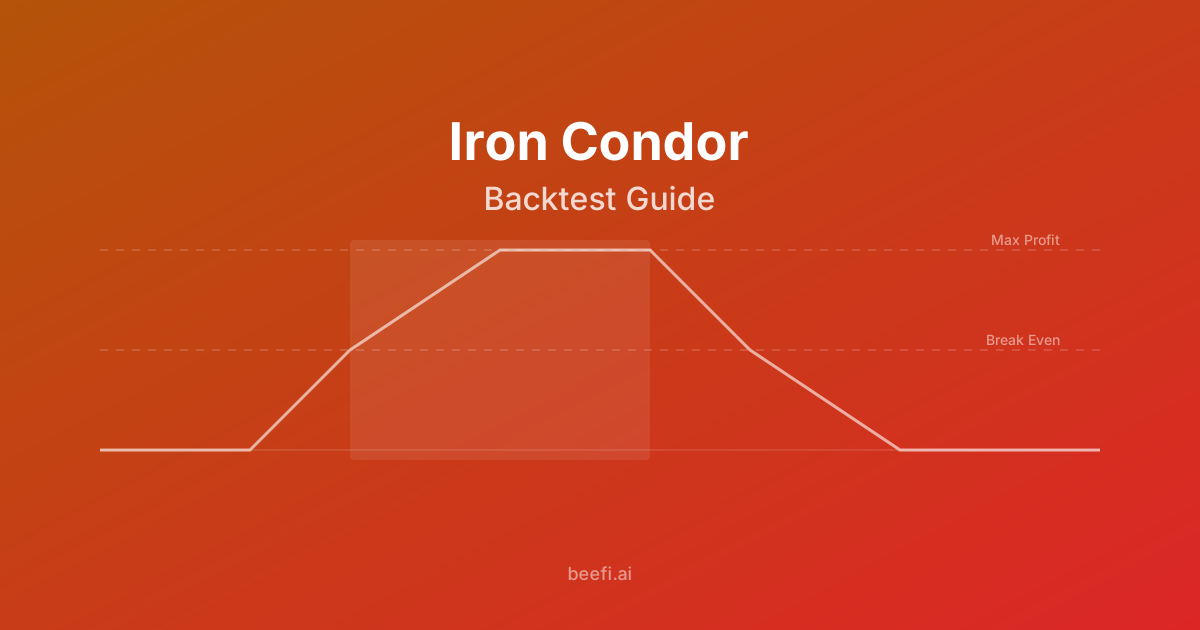
You profit when the stock stays between your short strikes at expiration. Maximum profit equals the total premium received; maximum loss is the width of the wider spread minus premium.
Why Backtest Iron Condors?
Every stock has different volatility characteristics. An iron condor that works on SPY might fail on TSLA. Backtesting reveals:
- Win rate — What percentage of trades are profitable?
- Average P&L — What’s the expected return per trade?
- Max drawdown — What’s the worst losing streak?
- Optimal strike width — How wide should your spreads be?
- Best entry timing — When should you open positions (DTE, IV percentile)?
Step-by-Step Backtesting Process
Step 1: Define Your Strategy
Choose your parameters:
- Underlying: The stock or ETF (e.g., SPY, QQQ, AAPL)
- Days to expiration (DTE): Typically 30-45 days for iron condors
- Short strike delta: Usually 0.15-0.30 delta (OTM probability)
- Wing width: 1-5 strikes wide depending on capital
- Position size: Percentage of portfolio per trade
Step 2: Set Your Test Period
Choose a backtesting window that includes different market conditions:
- Bull markets
- Bear markets
- High volatility (VIX spikes)
- Low volatility (quiet markets)
A minimum of 2-3 years gives meaningful results.
Step 3: Run the Backtest
Using Beefi.ai’s backtesting engine, our Black-Scholes pricing model calculates theoretical option prices at every point. For each trade, the system:
- Opens the position at your specified DTE
- Calculates daily P&L using Black-Scholes
- Monitors the Greeks (Delta, Gamma, Theta, Vega)
- Closes at expiration or your exit rules
- Records the result
Step 4: Analyze the Results
Key metrics to evaluate:
| Metric | Good Target | Description |
|---|---|---|
| Win Rate | > 70% | Percentage of profitable trades |
| Avg Return | > 5% per trade | Average return on risk |
| Max Drawdown | Less than 20% | Worst peak-to-trough decline |
| Sharpe Ratio | > 1.0 | Risk-adjusted return measure |
| Profit Factor | > 1.5 | Gross profits / gross losses |
Step 5: Optimize
Adjust parameters and re-run:
- Try different delta levels for short strikes
- Test different DTEs (21 vs 30 vs 45 days)
- Add management rules (close at 50% profit, roll at 21 DTE)
- Test different underlyings
Understanding the Greeks for Iron Condors
Theta (Time Decay)
Theta is your friend with iron condors. Your position should have positive Theta, meaning you earn money each day the stock stays in range. Higher Theta = faster premium decay in your favor.
Delta (Directional Risk)
A well-structured iron condor starts with near-zero Delta (market neutral). If Delta drifts significantly positive or negative, the stock is moving toward one of your short strikes.
Vega (Volatility Risk)
Iron condors have negative Vega — they lose value when implied volatility increases. Opening positions when IV is relatively high (above 50th percentile) gives you an edge.
Gamma (Acceleration Risk)
Gamma works against iron condors near expiration when the stock is close to a short strike. This is why many traders close positions 7-14 days before expiration.
Common Iron Condor Mistakes
- Strikes too narrow — Higher premium but much higher loss frequency
- Ignoring IV environment — Selling when IV is low gives tiny premiums
- No management rules — Always have exit criteria for losing trades
- Same stock bias — Backtest across multiple underlyings
- Overfitting — Don’t optimize to historical data so tightly that the strategy fails going forward
Try It on Beefi.ai
Our options backtesting engine lets you test iron condors (and other strategies) with real historical data. The Black-Scholes pricing model calculates accurate theoretical prices, and you get full Greeks analysis for every position.
Start with a strategy template, set your parameters, and see exactly how your iron condor would have performed.